Don't miss our holiday offer - up to 50% OFF!
How to Measure Yourself for a Made-to-Order Leather Jacket
Learn how to take accurate chest, shoulder, sleeve, waist and jacket-length measurements before ordering a made-to-order leather jacket.

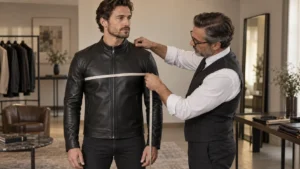
Learning how to measure for a leather jacket is essential when the garment will be created after your order. Accurate measurements help the jacket sit correctly across the shoulders, provide appropriate room through the chest and finish at the intended points on the wrists and body.
You do not need specialist tailoring equipment, but you should use a flexible measuring tape and ask another person to assist you. Measuring yourself without help—particularly across the shoulders and down the sleeves—can produce inaccurate results.
This guide explains what to wear, how to stand and how to record the body and garment measurements needed for a made-to-order leather jacket.
Before You Begin Measuring
Prepare the following:
- A flexible fabric measuring tape
- A mirror
- A pen and measurement form
- A second person to assist you
- The type of clothing you expect to wear under the jacket
- A well-fitting jacket for comparison, if available
Do not use a rigid metal tape measure. It will not follow the body accurately.
Take every measurement at least twice. If two results differ, repeat the measurement instead of estimating between them.
Record all measurements in one unit—either centimetres or inches. Do not combine the two.
What Should You Wear While Being Measured?
Wear a lightweight, close-fitting shirt or T-shirt if the jacket will usually be worn over light clothing.
If you expect to wear the leather jacket over a sweater or another substantial layer, wear a similar layer while being measured and mention this when ordering.
Avoid measuring over:
- Bulky coats
- Oversized hoodies unless these are your intended layers
- Garments with padded shoulders
- Heavy items in the pockets
- Belts or accessories that change the body’s natural shape
The goal is to record your actual proportions while accounting for the clothing you genuinely intend to wear beneath the jacket.
How Should You Stand?
Stand naturally with:
- Feet approximately shoulder-width apart
- Shoulders relaxed
- Arms resting naturally
- Normal breathing
- Your back straight but not forced
- Your stomach in its natural position
Do not expand your chest, pull in your stomach or raise your shoulders. A measurement taken in an unnatural posture can produce an uncomfortable jacket.
The measuring tape should lie close to the body without compressing it. Keep it level where a horizontal measurement is required.
Body Measurements vs Jacket Measurements
Body measurements and finished-jacket measurements are not interchangeable.
A body measurement records the wearer’s actual dimensions. A finished jacket requires additional room for movement, layering and the intended silhouette. This additional room is called ease.
When providing body measurements:
Do not add extra room yourself unless the brand specifically requests it.
The pattern maker should determine the appropriate garment ease according to the jacket design and your preferred fit.
Measurements taken from a jacket you already own are garment measurements. Label them clearly so they are not mistaken for body measurements.
Essential Leather Jacket Measurements
The following measurements provide the main information needed to assess jacket size and proportions.
1. Height
Stand without shoes against a wall and measure from the floor to the top of your head.
Height does not determine size on its own, but it helps assess the relationship between sleeve length, jacket length and overall proportions.
Record:
Height: ___ cm/in
2. Chest Circumference
Wrap the tape around the fullest part of your chest. It should pass beneath the arms and remain level across the shoulder blades.
Keep your arms relaxed and breathe normally. The tape should touch the body without being pulled tightly.
Do not deliberately add extra inches or centimetres. Record the actual measurement.
Record:
Chest circumference: ___ cm/in
This measurement helps determine the jacket body size, but it must be considered alongside the shoulders, waist and intended layering.
3. Natural Waist
Measure around the narrowest part of your torso, usually above the navel.
If the jacket is straight rather than shaped at the natural waist, an additional measurement may be required at the point where the jacket will close or finish.
Keep the tape level and avoid pulling it into the body.
Record:
Natural waist: ___ cm/in
4. Lower Waist or Jacket Hem
Identify where the bottom of the selected jacket is expected to sit. Wrap the tape around your body at that position.
This measurement is particularly important for:
- Waist-length café racers
- Leather bombers
- Cropped jackets
- Jackets with fitted waistbands
- Designs with adjustable waist tabs
Record:
Lower waist or hem circumference: ___ cm/in
If the hem measurement is taken at a specific location, note where that location sits—for example, at the belt line or upper hip.
5. Seat or Hip Circumference
Measure around the fullest part of the hips and seat while standing naturally.
This measurement may not be necessary for a short waist-length jacket, but it becomes important for longer overshirts, field jackets and coats that extend over the hips.
Record:
Seat or hip circumference: ___ cm/in
6. Shoulder Width
Ask another person to measure across your upper back from one natural shoulder point to the other.
The shoulder point is where the shoulder ends and the upper arm begins. Follow the body’s natural shape rather than pulling the tape into a suspended straight line.
Do not measure from the outside edges of an oversized shirt because its seams may not correspond with your natural shoulder points.
Record:
Shoulder width: ___ cm/in
Shoulder width is one of the most important measurements because substantial shoulder alterations can be difficult after a leather jacket has been constructed.
7. Sleeve Length
Place the beginning of the tape at the natural shoulder point.
With the arm slightly bent, run the tape:
- From the shoulder point
- Along the outside of the upper arm
- Over the elbow
- Down to the wrist bone or desired cuff position
Do not measure with the arm completely straight. A slight bend accounts for the path the sleeve must follow during movement.
Record:
Sleeve length: ___ cm/in
If the design is motorcycle-inspired, the intended sleeve may be slightly longer to account for a forward arm position.
8. Bicep Circumference
Wrap the tape around the fullest part of the upper arm while keeping the arm relaxed.
Do not flex the muscle unless specifically requested. The pattern maker will add the required movement room.
Record:
Bicep circumference: ___ cm/in
This measurement is particularly useful for fitted jackets or wearers with athletic arms.
9. Wrist or Cuff Circumference
Measure around the wrist at the point where the jacket cuff will finish.
If you regularly wear a watch beneath the jacket, mention this or measure over the watch if that represents your normal use.
Record:
Wrist circumference: ___ cm/in
The required finished cuff will depend on whether the jacket uses zippers, snaps, ribbing or an open sleeve finish.
10. Back Length
Locate the prominent bone at the base of the neck. Measure vertically down the centre of the back to the intended jacket hem.
Stand naturally and keep the tape following the body.
Record:
Back length: ___ cm/in
The intended back length depends on the design:
- Café racer: commonly around the waist or upper hip
- Bomber: usually near the waist, depending on the waistband
- Trucker jacket: generally around the belt line
- Leather overshirt: usually longer
- Field jacket: may extend over the hips
Do not change the intended length of a design without considering its pockets, zipper, waist shaping and overall balance.
11. Front Length
Place the tape at the point where the shoulder meets the neck. Measure down the front of the body to the intended jacket hem.
Allow the tape to follow the chest naturally.
Record:
Front length: ___ cm/in
This can be useful when front and back proportions differ or when the wearer has a prominent chest or stomach.
12. Neck Circumference
Wrap the tape around the base of the neck where a jacket collar will sit. Keep one finger beneath the tape so it is not restrictive.
Record:
Neck circumference: ___ cm/in
This is especially relevant for funnel-neck, stand-collar and closely fastened café-racer jackets.
Jacket Measurement Checklist
Record these measurements before placing an order:
| Measurement | Result |
|---|---|
| Height | ___ |
| Chest circumference | ___ |
| Natural waist | ___ |
| Lower waist or hem | ___ |
| Seat or hips, if required | ___ |
| Shoulder width | ___ |
| Sleeve length | ___ |
| Bicep circumference | ___ |
| Wrist circumference | ___ |
| Back length | ___ |
| Front length, if requested | ___ |
| Neck circumference | ___ |
| Preferred unit | cm/in |
Also provide:
- Your usual jacket size
- Your preferred fit
- What you intend to wear underneath
- Any relevant posture or proportion information
- Whether the measurements are body or garment measurements
How to Measure a Jacket You Already Own
A well-fitting jacket can provide a useful reference, particularly when ordering online.
Choose a jacket with a silhouette similar to the leather jacket you intend to order. A loose winter coat is not a reliable reference for a fitted café racer.
Fasten the jacket and lay it flat on a level surface without stretching it.
Measure the chest
Measure straight across from one armpit seam to the other. This is the half-chest measurement.
Do not double it unless the measurement form specifically asks for the full approximate circumference.
Measure the shoulders
Measure across the back from one shoulder seam to the other.
Measure the sleeve
Measure from the shoulder seam along the outside of the sleeve to the cuff.
Measure the back length
Measure from the base of the collar seam down the centre back to the hem.
Measure the hem
Measure straight across the bottom of the fastened jacket.
Measure the bicep
Measure across the upper sleeve at its widest point.
Clearly mark these as garment measurements when submitting them.
Choosing Your Preferred Fit
Measurements alone do not communicate the complete fit preference. Two people with the same chest measurement may prefer very different silhouettes.
Choose one of the following descriptions:
Close fit
The jacket follows the body with limited layering room. Best suited to lightweight shirts or T-shirts.
Regular fit
The jacket maintains a clean silhouette while providing practical movement and room for a light layer.
Relaxed fit
The jacket has additional ease through the body and sleeves and can accommodate more substantial layering.
Do not request a close fit if you intend to wear the jacket regularly over thick knitwear.
For more guidance, read How Should a Leather Jacket Fit?.
Common Measurement Mistakes
Measuring without assistance
Shoulder width, sleeve length and back length are difficult to measure accurately alone.
Pulling the tape too tightly
A tight tape records a compressed measurement and can result in insufficient room.
Adding ease to body measurements
Provide your actual body dimensions. Adding extra room yourself can cause ease to be added twice.
Mixing body and garment measurements
Always label whether a result was taken from your body or from an existing jacket.
Measuring over unsuitable clothing
Bulky or padded garments can significantly change the result.
Standing unnaturally
Pulling in the stomach or lifting the chest will not reflect your normal wearing posture.
Measuring only once
Repeat every measurement and investigate any difference.
Assuming a usual size is sufficient
Sizing differs between brands and jacket designs. “Medium” alone does not describe your proportions.
Confusing shoulder-to-cuff with centre-back sleeve length
Use the exact measuring method requested. These are different sleeve measurements.
Using an unrelated reference garment
Compare the new design with a garment of similar length, structure and intended fit.
How Accurate Should Measurements Be?
Record measurements as accurately as your tape allows without creating false precision.
Consistency is more important than repeatedly changing a measurement by very small amounts. If two attempts differ considerably, check:
- Tape position
- Posture
- Clothing
- Whether the tape remained level
- Whether the same starting and ending points were used
Do not estimate a measurement you were unable to take. Ask for assistance or contact the brand for clarification.
What Happens After Measurements Are Submitted?
For a made-to-order jacket, submitted measurements should be reviewed together rather than treated as unrelated numbers.
The review may consider:
- Whether the measurements are internally consistent
- How they compare with the selected base size
- The intended jacket silhouette
- Layering preferences
- Leather thickness and structure
- Jacket length
- Sleeve and shoulder proportions
- Any unusual measurement difference requiring confirmation
If a measurement appears inconsistent, it should be confirmed before the leather is cut.
At Basharat Atelier, measurement review forms part of the pre-production process. It allows the selected jacket to be refined to the wearer’s proportions while preserving the intended design.
Explore the leather-jacket collection or learn more about our approach to construction.
Frequently Asked Questions
Should I add extra room to my chest measurement?
No, not unless the measurement instructions specifically request it. Provide your actual body measurement and state your preferred fit and intended layers. The necessary garment ease should be determined during sizing and pattern review.
Can I measure myself without help?
Chest, waist and bicep measurements may be manageable alone, but shoulder width, sleeve length and back length are more reliable when taken by another person.
Should I measure in inches or centimetres?
Either unit can work. Use one unit consistently, identify it clearly and avoid converting measurements repeatedly.
Should I measure over a T-shirt or sweater?
Measure over clothing similar to what you expect to wear under the jacket. If you intend to use both, explain which type of layer should receive priority.
Can I submit measurements from another jacket?
Yes, provided you identify them as garment measurements and the reference jacket has a similar silhouette. Body measurements may still be required.
How tight should the measuring tape be?
The tape should rest close to the body without compressing it. You should not pull it tightly or leave it hanging loosely.
What if one of my measurements looks unusual?
Repeat the measurement using the same defined points. If it remains unusual, submit the accurate result and mention it rather than adjusting it to resemble a standard chart.
Are height and weight enough to determine jacket size?
No. They provide context but cannot replace chest, shoulder, sleeve, waist and length measurements.
Will a made-to-order jacket fit without accurate measurements?
No measurement-based process can compensate for incorrect information. Measurements must be taken carefully, and any questions should be resolved before production.
Measure Carefully Before Confirming
A considered leather-jacket fit begins with reliable information.
Use a flexible tape, ask another person to help, measure over appropriate clothing and record every result twice. Provide actual body measurements without adding your own ease, and clearly separate them from measurements taken from an existing jacket.
Once the measurements, intended fit and selected design are considered together, the jacket can be prepared with a clearer understanding of the wearer’s proportions.