Don't miss our holiday offer - up to 50% OFF!
How Should a Leather Jacket Fit? A Complete Measurement Guide
Discover how a leather jacket should fit across the shoulders, chest, sleeves and waist, and learn how to take accurate measurements before ordering.

A well-fitting leather jacket should feel close and structured without restricting natural movement. It should sit cleanly across the shoulders, fasten comfortably through the chest and allow enough room for the clothing you intend to wear underneath.
Understanding how a leather jacket should fit is particularly important because leather behaves differently from woven outerwear. It may soften and form more closely to the body with wear, but it should not be expected to correct an unsuitable size or poor proportions.
This guide explains how to assess the shoulders, chest, sleeves, waist and jacket length—and how to take useful measurements before ordering.
What Does a Good Leather Jacket Fit Look Like?
A good fit creates a clean silhouette while allowing practical movement. When the jacket is fastened, the front should lie smoothly without pronounced pulling around the chest, stomach or zipper. The back should appear controlled rather than excessively loose, and the shoulders should follow the wearer’s natural proportions.
The correct fit also depends on the intended silhouette. A café racer will generally sit closer to the body than a leather bomber, while an overshirt or relaxed jacket requires more ease.
The objective is not to make every style equally slim. It is to preserve the intended design while ensuring that its proportions work for the wearer.
A well-fitting leather jacket should:
- Sit cleanly across the shoulders
- Fasten without strain
- Allow comfortable arm movement
- Provide appropriate room for layering
- Finish at the intended point on the body
- Maintain balanced proportions from the front, side and back
How Should a Leather Jacket Fit at the Shoulders?
The shoulders are one of the most important areas to evaluate. On a traditionally fitted jacket, the shoulder seam should sit close to the natural edge of the shoulder. It should not pull inward toward the neck or fall substantially down the upper arm.
However, the seam position must be interpreted according to the design. Jackets with dropped or extended shoulders are intentionally constructed differently and should not be judged by conventional tailored-jacket rules.
Signs that the shoulders may be too narrow include:
- Tension across the upper back
- The collar being pulled away from the neck
- Restricted forward arm movement
- Creases radiating from the shoulder or armhole
- The jacket rising excessively when the arms move
Signs that the shoulders may be too wide include:
- Collapsed or hollow areas around the shoulder
- Sleeves beginning too far down the arm
- Excess fabric across the upper back
- A generally unsupported appearance
Shoulder width is difficult and costly to alter after a leather jacket has been constructed. It should therefore be reviewed carefully before ordering.
How Should the Chest Fit?
The jacket should follow the chest without compressing it. You should be able to close the zipper or buttons comfortably while standing naturally.
A small amount of horizontal tension can appear on a close-fitting leather jacket, but strong pulling, distorted seams or a visibly strained zipper usually indicates insufficient room.
When the jacket is too large through the chest, it may produce:
- Excess vertical folds
- Bulging fabric around the armholes
- A loose or boxy front
- Too much movement between the body and garment
Remember that body measurements and finished-garment measurements are not the same. A jacket requires additional room—known as ease—to accommodate movement, clothing and the intended silhouette. Do not order a jacket with a finished chest measurement identical to your body chest measurement.
How Should the Waist and Hem Fit?
The waist and hem depend on the jacket style.
A fitted café-racer jacket may gently follow the waist, while a bomber commonly uses a straighter body or fitted waistband. A leather overshirt may be intentionally relaxed through the waist and hem.
Regardless of style, the jacket should not pull sharply across the stomach when fastened. The hem should sit evenly and should not rise significantly at the front or back.
For jackets with adjustable waist tabs, the body should fit properly before the tabs are tightened. Adjustment tabs are intended for refinement, not for correcting a jacket that is substantially too large.
Where Should Leather Jacket Sleeves End?
For most everyday leather jackets, the sleeve should finish around the wrist bone or slightly beyond it when the arms are relaxed.
The sleeve should not cover a large part of the hand during normal wear. It should also not rise so far during movement that a substantial section of the wrist and lower forearm becomes exposed.
Motorcycle-inspired styles may use slightly longer sleeves because the arms extend forward while riding. Fashion and casual jackets can generally use a more conventional wrist-length finish.
When checking sleeve length:
- Stand naturally with your arms relaxed.
- Check where the cuff meets the wrist.
- Bend your elbows.
- Reach your arms forward.
- Confirm that the sleeve remains comfortable without excessive pulling.
Sleeve length can sometimes be altered, but zippers, working cuffs, lining construction and decorative details can make changes difficult.
How Should the Armholes and Sleeves Feel?
A higher, well-shaped armhole can provide a clean appearance and good movement when constructed correctly. An armhole that is too tight can press into the underarm and restrict movement, while an excessively low armhole may cause the entire jacket body to lift when the arms are raised.
The upper sleeve should provide enough room around the bicep without producing excessive loose fabric.
Test the jacket by:
- Reaching both arms forward
- Bending the elbows
- Raising each arm naturally
- Sitting down while the jacket is fastened
- Crossing the arms gently
- Reaching toward an imaginary steering wheel
Some resistance is natural in structured leather, particularly when the jacket is new. Pain, numbness, severe pressure or heavily distorted seams are not signs of an appropriate break-in period.
Where Should a Leather Jacket Finish?
Jacket length changes the entire proportion of the garment.
A traditional café racer or bomber usually finishes around the waist or upper hip. A leather trucker often sits around the belt line, while an overshirt or field jacket may extend farther down the body.
The correct length should be considered in relation to:
- The jacket style
- The wearer’s torso length
- Trouser rise
- Intended layering
- Overall body proportions
A jacket should not be made shorter simply to appear fashionable if the resulting proportion does not suit the wearer or design.
When taking measurements, measure the required back length from the prominent bone at the base of the neck down to the intended hem position.
Should a New Leather Jacket Feel Tight?
A new leather jacket can feel firmer than it will after regular wear. Natural leather gradually softens and may form more closely around the shoulders, elbows and other movement areas.
However, a jacket should not be purchased significantly too small in the expectation that it will stretch into the correct size.
Leather may relax modestly in areas exposed to repeated tension, but:
- Shoulder width will not meaningfully correct itself
- Sleeve length will not increase
- Jacket length will not change
- A strained zipper will not become properly positioned
- Incorrect garment proportions will remain incorrect
A new jacket should feel close if the design is fitted, but it should still fasten and permit ordinary movement.
Consider What You Will Wear Underneath
Before choosing a size, decide how the jacket will normally be worn.
If it will mainly be worn over a lightweight T-shirt or shirt, less layering room is required. If it will be worn over knitwear, a hoodie or heavier winter clothing, the pattern needs additional ease through the chest, armholes and sleeves.
Do not take measurements while wearing a T-shirt if you plan to wear the finished jacket over thick knitwear. Measure while wearing a representative layer and state your intended use when ordering.
The same jacket cannot deliver a sharply fitted appearance over a T-shirt and also accommodate very heavy layers without changing its silhouette.
How to Measure for a Leather Jacket
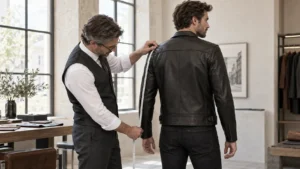
Use a flexible measuring tape and ask another person to help where possible. Stand naturally and avoid holding your breath or changing your posture.
Record measurements in either centimetres or inches and use the same unit throughout.
1. Chest
Measure around the fullest part of the chest, keeping the tape level across the back. The tape should sit close to the body without compressing it.
2. Natural waist
Measure around the natural waist or the part of the torso where the jacket is intended to shape. Do not pull the tape tightly.
3. Lower waist or hem
Measure around the body at the intended jacket hem position. This is particularly important for shorter jackets and styles with a fitted hem.
4. Shoulder width
Measure across the back from one natural shoulder point to the other. Follow the body’s shape rather than pulling the tape into a straight suspended line.
5. Sleeve length
Measure from the shoulder point, over a slightly bent elbow, to the desired cuff position at the wrist.
6. Bicep
Measure around the fullest area of the upper arm while keeping the arm relaxed.
7. Back length
Measure from the base of the neck down the centre of the back to the intended jacket hem.
8. Height and weight
Height and weight do not determine jacket size on their own, but they provide useful context when measurements and proportions are reviewed together.
For additional instructions, visit our Size & Fit guide.
Body Measurements vs Garment Measurements
One of the most common ordering mistakes is confusing body measurements with garment measurements.
A body chest measurement is taken around the wearer. A garment chest measurement is taken from the finished jacket and already includes the ease required for fit and movement.
When measuring a jacket you already own:
- Fasten the jacket.
- Lay it flat without stretching it.
- Smooth the garment naturally.
- Measure from armpit to armpit.
- Double that measurement for the approximate chest circumference.
- Record the shoulder, sleeve, back length and hem measurements separately.
Comparing a preferred jacket can be helpful, but only when its fabric, thickness and silhouette are reasonably similar to the new design.
Common Signs That a Leather Jacket Is Too Small
A jacket may be too small when:
- The zipper is difficult to close
- Strong horizontal pulling appears across the chest
- The collar is pulled away from the neck
- The shoulders or underarms cause discomfort
- The body rises significantly when the arms move
- The sleeves pull heavily at the elbows
- The hem cannot sit evenly when fastened
A deliberately close fit should still be wearable. Discomfort should not be treated as evidence of luxury tailoring.
Common Signs That a Leather Jacket Is Too Large
A jacket may be too large when:
- The shoulder line collapses or extends unintentionally
- Excess fabric gathers around the armholes
- The back forms deep uncontrolled folds
- The sleeves cover much of the hands
- The body lacks the intended structure
- The hem hangs away from the wearer
- The jacket moves excessively around the torso
An oversized jacket can be intentional, but it should still have controlled proportions. Oversized design is not the same as wearing an incorrectly graded size.
How Leather Type Influences Fit
Different leathers produce different silhouettes.
Lambskin is generally soft, lightweight and fluid. It is well suited to refined jackets that need to follow the body with minimal bulk.
Cowhide is usually more substantial and structured. Depending on its thickness and finishing, it may require more break-in time and produce a stronger silhouette.
Suede and nubuck can feel softer but still vary significantly in weight and structure. The leather selection should therefore be considered together with the pattern, lining and intended fit.
Learn more in our guide to lambskin and cowhide leather jackets.
The Basharat Atelier Approach to Fit
Every Basharat Atelier jacket begins after an order is placed. The selected size, body measurements and intended fit are reviewed before the leather is cut.
This process allows the jacket’s proportions to be considered more carefully than selecting a standard size without any measurement review. It does not replace accurate information from the wearer, so measurements must be taken carefully and submitted honestly.
Once the relevant details are confirmed, the leather and components are prepared for production. You can learn more about the process on our Our Craft page or explore the leather-jacket collection.
Final Leather Jacket Fit Checklist
Before confirming your size, check that:
- The selected silhouette matches your preference
- The shoulders follow the intended design
- The jacket can be fastened comfortably
- The chest provides appropriate movement room
- The sleeves finish around the intended wrist position
- The jacket length works with your torso and clothing
- Your measurements were taken over suitable layers
- You used one consistent measurement unit
- You did not confuse body and garment measurements
- Any unusual posture or proportion has been communicated
Frequently Asked Questions
Should a leather jacket fit tightly?
A fitted leather jacket should sit close to the body, but it should not restrict breathing, create pain or prevent ordinary arm movement. The correct amount of ease depends on the design and intended layering.
Will a leather jacket stretch?
Natural leather can soften and relax modestly in areas exposed to movement and tension. It should not be expected to correct narrow shoulders, insufficient length or an unsuitable overall size.
Should I size up when buying a leather jacket?
Not automatically. Select a size according to the brand’s measurement chart, the intended silhouette and what you plan to wear underneath. Sizing up without considering these factors can result in incorrect shoulders and excessive body volume.
Where should leather-jacket sleeves finish?
For most casual leather jackets, sleeves should finish around the wrist bone or slightly beyond it with the arms relaxed. Motorcycle-inspired styles may intentionally use longer sleeves.
Can a leather jacket be altered?
Some sleeve, waist and body adjustments may be possible, but alterations depend on the lining, seams, hardware and construction. Shoulder changes and substantial resizing can be difficult and expensive.
What is the most important leather-jacket measurement?
No single measurement is sufficient. Chest, shoulder width, sleeve length, jacket length and hem circumference should be considered together. Shoulder and chest measurements are particularly important because major corrections are difficult after construction.
A Fit That Belongs to the Wearer
The best leather-jacket fit is neither universally tight nor deliberately loose. It is a balance between the garment’s intended silhouette, the wearer’s proportions, practical movement and expected layering.
Accurate measurements create the foundation. Considered pattern proportions, appropriate leather and careful construction turn those measurements into a jacket that feels natural to wear and improves with time.