Don't miss our holiday offer - up to 50% OFF!
Made-to-Order vs Ready-to-Wear Leather Jackets
Compare made-to-order and ready-to-wear leather jackets by fit, production process, delivery time, personalisation and convenience before deciding which option suits you.

The difference between made-to-order and ready-to-wear leather jackets begins with when and how the garment is produced.
A ready-to-wear jacket is manufactured in advance using a brand’s established size range. A made-to-order jacket is produced after a customer places an order, usually using an existing design and base pattern that may be refined according to selected measurements and options.
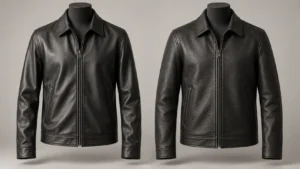
Neither system is automatically superior. Ready-to-wear offers speed and convenience, while made-to-order allows more consideration of size, proportions and material choices. The better option depends on your priorities, timeframe and willingness to participate in the ordering process.
Made-to-Order vs Ready-to-Wear at a Glance
| Consideration | Made-to-order | Ready-to-wear |
|---|---|---|
| Production | Begins after the order | Manufactured before purchase |
| Availability | Requires a production period | Usually available immediately |
| Sizing | Base size may be refined | Fixed standard sizing |
| Measurements | Often reviewed before cutting | Usually selected from a size chart |
| Personalisation | May include limited options | Usually limited to available variants |
| Fit confirmation | Can occur before production | Customer assesses the finished garment |
| Returns | May be restricted | Usually more flexible |
| Inventory | Less dependence on finished stock | Requires stock in advance |
| Customer involvement | Higher | Lower |
| Best suited to | Considered fit and planned purchase | Convenience and immediate availability |
The exact service varies between brands. Customers should read the product description, production information and returns policy before ordering.
What Is a Ready-to-Wear Leather Jacket?
A ready-to-wear leather jacket is produced in advance using predetermined sizes such as XS, S, M, L and XL.
The brand creates a base pattern, grades it across its size range and manufactures a quantity of finished jackets before customer orders are placed.
The customer selects the closest available size and receives an already completed garment.
Ready-to-wear does not mean low quality. A ready-to-wear jacket can use excellent leather, balanced patterns, reliable hardware and highly skilled construction. The term describes the production model—not the quality level.
Advantages of ready-to-wear jackets
- Immediate or relatively fast dispatch
- Ability to try on the completed garment
- Straightforward size selection
- Easier exchanges when another size is available
- Usually more flexible returns
- No measurement submission
- Consistent, predetermined design
- Suitable for urgent purchases
Limitations of ready-to-wear jackets
- Fixed proportions
- Limited ability to adjust sleeves or body length
- Standard shoulder and chest relationships
- Potential difficulty for non-standard proportions
- Dependence on available stock
- Limited material and hardware choices
- The closest size may still require compromise
Ready-to-wear works particularly well when the brand’s standard pattern already suits the wearer.
What Is a Made-to-Order Leather Jacket?
A made-to-order leather jacket is produced after an order has been placed.
The customer usually selects an existing jacket design, base size, leather option and available details. Measurements may then be reviewed so that permitted areas of the pattern can be refined before cutting.
The extent of adjustment varies between brands. Some made-to-order services only produce a standard size after purchase. Others review several body measurements and modify specified proportions.
A responsible product page should clearly explain what the service includes.
Advantages of made-to-order jackets
- Production begins specifically for the customer
- Measurements can be reviewed before cutting
- Some proportions may be refined
- Leather and colour options may be available
- Selected details may be confirmed before production
- Less reliance on finished inventory
- The ordering experience can be more considered
- Useful for customers who struggle with standard proportions
Limitations of made-to-order jackets
- Production requires additional time
- Accurate customer measurements are essential
- Changes may be restricted after confirmation
- Returns can be limited for adjusted products
- The customer cannot inspect the finished jacket before production
- Not every design detail can be changed
- The process requires more customer involvement
- The result still depends on the maker’s pattern and construction
Made-to-order should not be presented as a guarantee of perfect fit. It improves the information available before production, but the customer must supply accurate measurements and understand the intended silhouette.
Made-to-Order Is Not Necessarily Bespoke
Made-to-order and bespoke are often used interchangeably in marketing, but they do not mean exactly the same thing.
Made-to-order
Made-to-order generally begins with an existing design and base pattern. The garment is produced after purchase, and selected measurements or details may be adjusted within an established system.
Bespoke
Bespoke traditionally involves developing an individual pattern for one client. It may include consultations, fittings, pattern corrections and a greater degree of design control.
A made-to-order jacket should not be described as bespoke unless the service genuinely includes an individually developed pattern and the fittings associated with that process.
Basharat Atelier uses made-to-order because customers choose an established jacket design and their submitted measurements are reviewed before production. This is more accurate than claiming that every order is fully bespoke.
Comparing the Fit
Fit is one of the main reasons customers consider made-to-order.
Ready-to-wear fit
A ready-to-wear jacket uses fixed relationships between measurements. For example, a particular size has a predetermined:
- Chest circumference
- Shoulder width
- Sleeve length
- Waist
- Hem
- Back length
- Bicep width
If your proportions align with the brand’s pattern, ready-to-wear can fit very well. If they do not, you may need to choose between competing requirements.
A customer may require a larger chest but shorter sleeves, or broad shoulders with a relatively narrow waist. A fixed size may not accommodate both needs.
Made-to-order fit
A measurement-reviewed made-to-order service can consider these relationships before the leather is cut.
Depending on the design and service, refinements may be possible to:
- Sleeve length
- Body length
- Chest allowance
- Waist allowance
- Hem circumference
- Bicep width
- Shoulder proportion
Not every measurement should be altered independently. Changes affect the surrounding pattern pieces and the balance of the garment.
For example, increasing chest room may affect the armholes, front balance and sleeve relationship. Pattern adjustments should therefore be considered as a connected system.
Read How Should a Leather Jacket Fit? before choosing your preferred silhouette.
The Importance of Accurate Measurements
Made-to-order relies on the information provided by the customer.
Incorrect measurements can result from:
- Measuring without assistance
- Pulling the tape too tightly
- Adding ease to body measurements
- Mixing body and garment measurements
- Measuring over unsuitable clothing
- Using inconsistent measuring points
- Combining inches and centimetres
- Attempting to change posture during measurement
Measurements should be repeated and clearly identified.
The customer should also state:
- Their preferred fit
- Intended layering
- Usual jacket size
- Height
- Whether measurements are from the body or a garment
- Any relevant proportion or posture information
Follow our guide on how to measure for a made-to-order leather jacket before submitting your details.
Production Time
Ready-to-wear is the appropriate choice when a jacket is needed quickly. Because the garment already exists, dispatch can normally begin after payment and order processing.
Made-to-order requires time for:
- Order review
- Measurement checking
- Detail confirmation
- Leather selection
- Pattern preparation
- Cutting
- Construction
- Finishing
- Quality control
- Shipping
The brand should provide an estimated production period separately from delivery time.
Customers should not order a made-to-order jacket for a fixed event unless the complete production and shipping window has been confirmed. Estimates can also be affected by material availability, measurement clarification and seasonal workload.
Personalisation
Ready-to-wear jackets normally offer only the variants already produced, such as:
- Size
- Colour
- Leather option
- Hardware finish
Made-to-order may provide additional controlled choices, including:
- Leather colour
- Hardware finish
- Lining
- Sleeve length
- Body length
- Limited fit refinements
- Selected monogramming
More options do not automatically create a better jacket. Excessive changes can disturb the original design and produce an inconsistent result.
A considered made-to-order service should define which elements can be changed and which must remain part of the established design.
Leather Selection
Both production methods can use high-quality leather.
A ready-to-wear brand selects materials for an entire production run. This can support consistency across stock when the hides are graded and allocated carefully.
In made-to-order production, leather is selected after the order is confirmed. This can allow the maker to consider the chosen colour, style and required garment panels at the time of cutting.
In either model, quality depends on:
- Leather suitability
- Hide selection
- Panel placement
- Grain balance
- Thickness
- Finishing
- Cutting
- Construction
The words “made-to-order” do not, by themselves, establish material quality.
Read What Makes a High-Quality Leather Jacket? for a complete quality checklist.
Price Differences
Made-to-order jackets often cost more than comparable mass-produced ready-to-wear jackets because production is organised individually rather than through a large completed run.
Potential additional work can include:
- Measurement review
- Customer communication
- Pattern adjustments
- Individual leather preparation
- Separate cutting
- Detail confirmation
- Individual production scheduling
- Additional quality control
However, price alone does not prove quality.
A high-priced made-to-order jacket can still be poorly constructed, and a ready-to-wear jacket can offer excellent materials and workmanship.
Evaluate the actual product specifications, construction, policies and evidence provided by the brand.
Returns and Adjustments
Returns are generally easier with ready-to-wear products because the item has not been changed for a specific customer and may be returned to general stock.
Made-to-order and measurement-adjusted products may have more restrictive cancellation, return or exchange conditions.
Before ordering, read:
- Cancellation policy
- Returns policy
- Measurement responsibility
- Adjustment policy
- Faulty-product procedure
- Production confirmation process
- Applicable consumer rights
Made-to-order status should never remove a customer’s rights concerning products that are faulty, misdescribed or incorrectly supplied where those rights apply.
Because consumer rights vary by destination, a brand’s published policy should be reviewed professionally for the markets in which it sells.
Inventory and Production
Ready-to-wear requires the brand to predict demand and manufacture stock before it is sold. Some sizes or colours may sell out while others remain unsold.
Made-to-order reduces dependence on completed inventory because production begins in response to a confirmed purchase. However, this does not make production waste-free.
Leather cutting still produces offcuts, and materials, sampling, packaging and shipping must still be managed responsibly.
Claims such as “zero waste” or “fully sustainable” should not be made without evidence.
Which Option Is More Convenient?
Ready-to-wear is usually more convenient for customers who want:
- Fast delivery
- Simple size selection
- Easier exchanges
- The ability to try the finished garment
- Minimal communication before purchase
Made-to-order is more appropriate for customers who value:
- Measurement review
- A planned purchasing process
- Controlled personalisation
- Consideration of proportions
- Production beginning after purchase
- Greater involvement before cutting
Convenience and consideration are different benefits. The correct priority depends on the customer.
Which Option Is Better for Unusual Proportions?
A measurement-reviewed made-to-order jacket can be useful when standard sizes repeatedly create the same problem, such as:
- Sleeves that are consistently too long or short
- A chest and waist that fall into different sizes
- Broad shoulders with a narrower body
- A longer or shorter torso
- Larger biceps relative to the chest size
However, the customer should confirm which adjustments the brand can actually make.
Some proportion differences may require extensive pattern development rather than a simple made-to-order adjustment. In such cases, a bespoke or specialist tailoring service may be more appropriate.
Which Should You Choose?
Choose ready-to-wear when:
- You need the jacket quickly
- A standard size fits you well
- You want to try the completed product
- Flexible returns are important
- You prefer a simple ordering process
- You do not require measurement adjustments
Choose made-to-order when:
- You can wait for production
- You want your measurements reviewed
- Standard sizes often create proportion problems
- You value controlled material or detail options
- You understand the confirmation process
- You accept the applicable returns conditions
- You can provide accurate measurements
Neither choice should be based on prestige alone.
Questions to Ask Before Ordering Made-to-Order
Ask the brand:
- Is the jacket produced only after my order?
- Which measurements are reviewed?
- Which pattern areas can be adjusted?
- Is this made-to-order or fully bespoke?
- What is the estimated production time?
- When do design and measurement details become final?
- Which leather and lining options are available?
- What happens if a measurement appears inconsistent?
- What is the adjustment policy?
- What are the cancellation and return conditions?
- How is a faulty or incorrectly supplied product handled?
- Is shipping time included in the production estimate?
Clear answers allow you to understand what you are purchasing before payment.
The Basharat Atelier Made-to-Order Approach
Basharat Atelier jackets are produced after an order is placed.
The customer selects an established jacket design and provides the requested measurements. Those details are reviewed together with the selected size, intended fit and expected layering.
Once the relevant measurements and product details are confirmed, the leather is selected and cutting begins.
This approach allows greater consideration of the wearer’s proportions while preserving the balance and identity of the original jacket design.
It is made-to-order—not a claim that every jacket is developed through a traditional bespoke fitting process.
Explore the Basharat Atelier leather-jacket collection or learn more about our approach to construction.
Frequently Asked Questions
Is made-to-order the same as custom-made?
The terms are used differently between brands. Made-to-order normally begins with an existing design or pattern, while custom-made may imply broader changes. Always check what the individual service includes.
Is made-to-order the same as bespoke?
No. Bespoke traditionally involves creating an individual pattern and may include multiple fittings. Made-to-order generally adapts an existing design or base pattern.
Does made-to-order guarantee a perfect fit?
No. It allows measurements and proportions to be considered before production, but the result still depends on measurement accuracy, pattern development, leather behaviour and construction.
Are ready-to-wear jackets lower quality?
No. Ready-to-wear describes when and how the jacket is produced. It does not determine material or construction quality.
How long does a made-to-order jacket take?
Production time varies by brand, design, material availability and workload. Check the current estimate before ordering and treat shipping as a separate period unless stated otherwise.
Can made-to-order jackets be returned?
Policies vary, and adjusted products may have restrictions. Review the brand’s cancellation, return, adjustment and faulty-product policies before ordering.
Is made-to-order more expensive?
It can be, because the order may require individual review, cutting, communication and production scheduling. Price differences depend on the specific brand and product.
What if my submitted measurements are wrong?
Contact the brand immediately. Changes may be possible before cutting, but they can become difficult or impossible after production begins.
Can every part of a made-to-order jacket be changed?
Usually not. Most services limit adjustments to specific measurements, materials or details so the original design remains balanced.
Which option is best for my first leather jacket?
Ready-to-wear may be more convenient when you are uncertain about your preferences. Made-to-order can be suitable when you understand the silhouette, can provide accurate measurements and are comfortable with the production period and policies.
Two Different Approaches to the Same Garment
Ready-to-wear offers availability, convenience and the ability to assess a completed product. Made-to-order provides a slower, more involved process in which selected measurements and details can be considered before the leather is cut.
The better choice depends on what you value.
Choose ready-to-wear when speed and flexibility matter most. Choose made-to-order when you value measurement review, controlled choices and a jacket produced in response to your order.